
Homeowners in Toronto spend a lot of time choosing the right flooring — the species, colour, width, finish — and then hit a wall (literally) when they get to the question of which direction to run the planks. It's one of the most common questions we get in our showroom at 3781 Victoria Park Ave, and the answer is part rule, part guideline, part myth, and part genuine architectural principle.
Here's the short version: in most GTA homes, run the floor perpendicular to the longest wall, or if the room is open-concept with multiple defining walls, run it perpendicular to the main visible wall. But there are specific exceptions that matter for Toronto homes specifically. Let's break it down.

The Standard Rule: Run It Perpendicular to the Longest Wall
The most widely cited rule in flooring installation is: run the planks perpendicular to the main subfloor joists, or if there's no joist direction to reference, perpendicular to the longest wall. The reason is structural: running perpendicular to joists provides the best support and stiffness, and it also visually anchors the room by creating a rhythm that matches the room's longer axis.
In a typical GTA living room — say, 18 feet long by 14 feet wide — the longest wall is the 18-foot wall. Running planks perpendicular to that wall means they run in the 14-foot direction (end-to-end across the shorter width). This creates the effect of making the room feel slightly wider because your eye tracks across the plank direction. Running the planks the other way — parallel to the 18-foot wall — would make the room feel longer and narrower, which is rarely the effect homeowners want.
For rooms with plywood subfloors (standard in GTA homes built after 1970), the plywood sheathing direction actually provides a reference: building codes typically require subfloor panels to be installed with the long axis perpendicular to the floor joists. In most GTA homes, you can determine joist direction by looking at the basement ceiling or checking which direction the subfloor panel seams run. Always run your finish floor perpendicular to the joists — running parallel can result in more noticeable flex and springiness underfoot.
The Toronto Condo Exception: Running Parallel to the Exterior Wall
Condos in North York, Scarborough, Markham, and Toronto present a different challenge. Condominium units typically have concrete slab subfloors — no joists to reference. In a condo, the rule changes: run the planks so they draw your eye toward the main feature wall or the window wall.
The window wall is typically the dominant visual element in a condo living room — especially in units with floor-to-ceiling windows, which are common in newer GTA developments. Running planks parallel to the window wall (so your eye travels across the plank length toward the windows) creates a sense of depth and pulls the room together visually. Running planks perpendicular to the window wall (so you're looking at the plank ends as you face the windows) fragments the view and can make the room feel choppy.
For Scarborough and North York condos with long, narrow living rooms (a common layout in high-rise buildings from the 1980s-2000s), running planks parallel to the long walls is almost always the better choice — it visually lengthens and anchors the room rather than making it feel like a hallway.
Directional Planks: Matching Your Hallway Direction
In GTA semi-detached and detached homes with hallways connecting rooms, the plank direction in adjacent rooms matters for visual continuity. The traditional approach: in rooms that open into each other without a door between them, run the planks in the same direction. This creates visual continuity and makes the space feel larger and more cohesive.
The complication: if you have a long hallway connecting a living room to a dining room, and the hallway runs perpendicular to the living room's natural plank direction, you have a choice to make. You can:
- Run all planks in the same direction (hallway direction) and accept the slightly off-direction look in the living room
- Use a transition strip at the hallway entrance and run planks differently in each room
- Run planks in the living room's preferred direction and use a threshold transition at the hallway
For GTA homes, we typically recommend running planks in the dominant room direction (usually living room or master bedroom) and using a transition strip at any doorway. Threshold bars and reducer strips are available at our showroom and are the standard approach for GTA flooring installations.
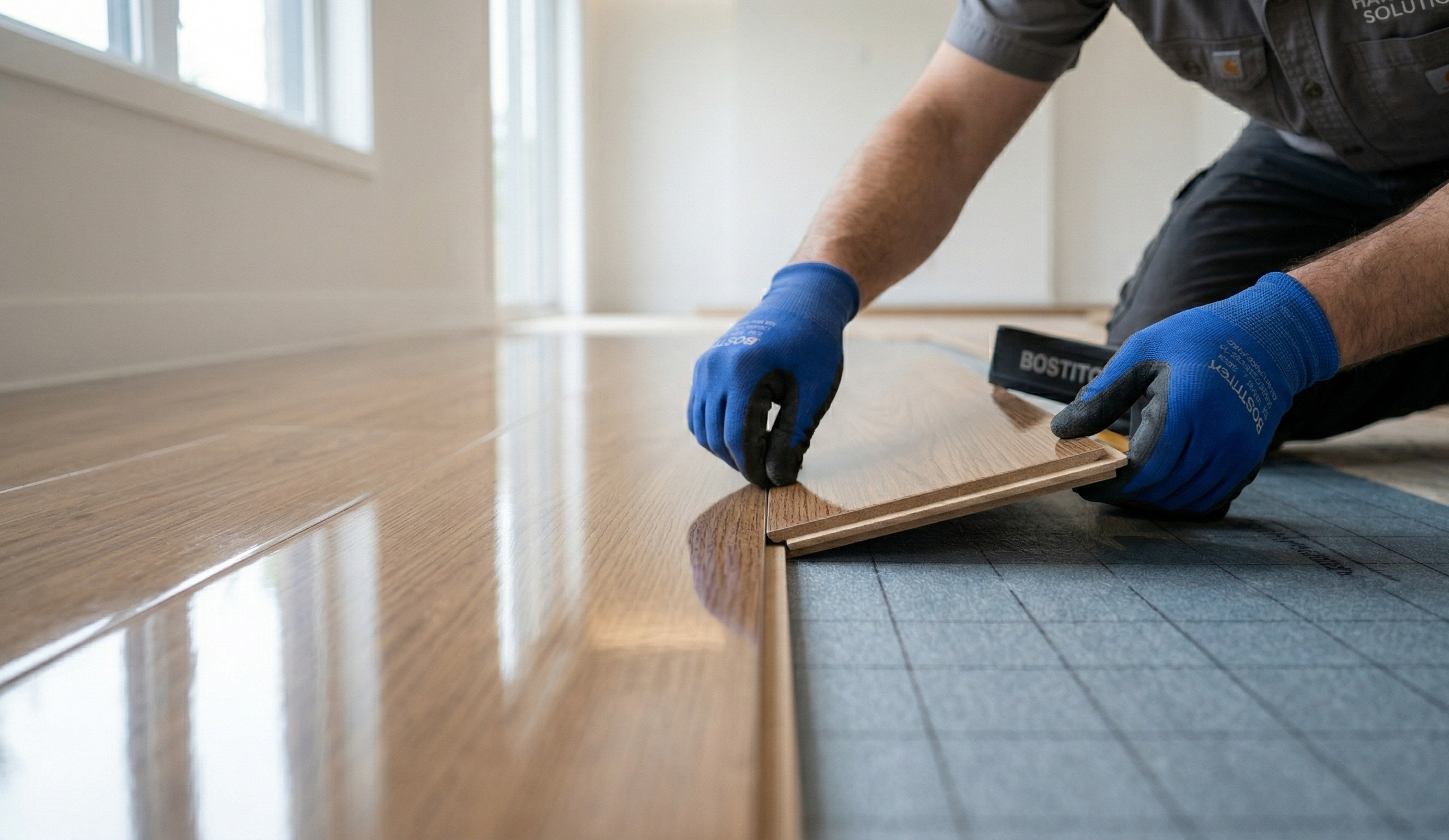
Does Floor Direction Affect Room Size Visually?
Yes — plank direction has a measurable effect on how a room reads visually:
- Planks running perpendicular to a wall (your eye travels the length of the plank): makes the wall you're looking at feel further away. Good for making a short wall feel longer.
- Planks running parallel to a wall (your eye travels across the plank width toward the far wall): makes the wall you're facing feel taller and the room feel deeper.
In practice: in a Scarborough living room with a 12-foot living room where you want to emphasize the window wall, run planks parallel to the window wall. In a Markham dining room where you want the room to feel more expansive, run planks perpendicular to the dining table's long axis.
The One Exception That Overrides Everything
If your subfloor is oriented parallel to your planned plank direction (which you can check by looking at the subfloor panel seams in your basement or utility room), you may need to add a layer of plywood orluan subfloor sheathing at 90 degrees to the joists before installing your finish floor. This is especially relevant in GTA homes built before 1980 where the original subfloor may have been installed parallel to the joists as a cost-saving measure.
For engineered hardwood and SPC vinyl installations over concrete, direction is less critical from a structural standpoint — the concrete subfloor doesn't flex in the way wood joist systems do. But the visual rules still apply.
Our Top Picks at Top Floorings Depot
If you're planning your floor direction and need the right product for the install:
European Oak Mocha 4mm — 7½" wide, wire-brushed. Our most popular wide-plank option for GTA living rooms and principal rooms. $4.99/sqft.
Riche Nordic Breeze Oak 9mm SPC — waterproof, 2mm EVA pad, 5.9" and 7.09" widths. Ideal for open-concept GTA condos where direction transitions between rooms are common. From $4.37/sqft.
Engineered Hardwood Installation Service — GTA-wide professional installation. Our installers understand the directional requirements for GTA subfloor conditions and will advise on the best plank direction for your specific home.
## Visit Top Floorings Depot **Top Floorings Depot** 3781 Victoria Park Avenue, Unit 1, Toronto, ON M1W 3K5 www.topfloorings.com Call 416-499-0117 | Text 416-770-8819 **Showroom Hours:** Monday–Friday 9–5:30 | Saturday 9–4 | Sunday Closed Our team can advise on the best plank direction for your specific room and subfloor. We serve homeowners and contractors across Toronto, Scarborough, North York, Markham, Richmond Hill, Vaughan, Mississauga, and the broader GTA. Follow us on Instagram: @topflooringsdepotgta